

What is Artificial Intelligence (AI)?
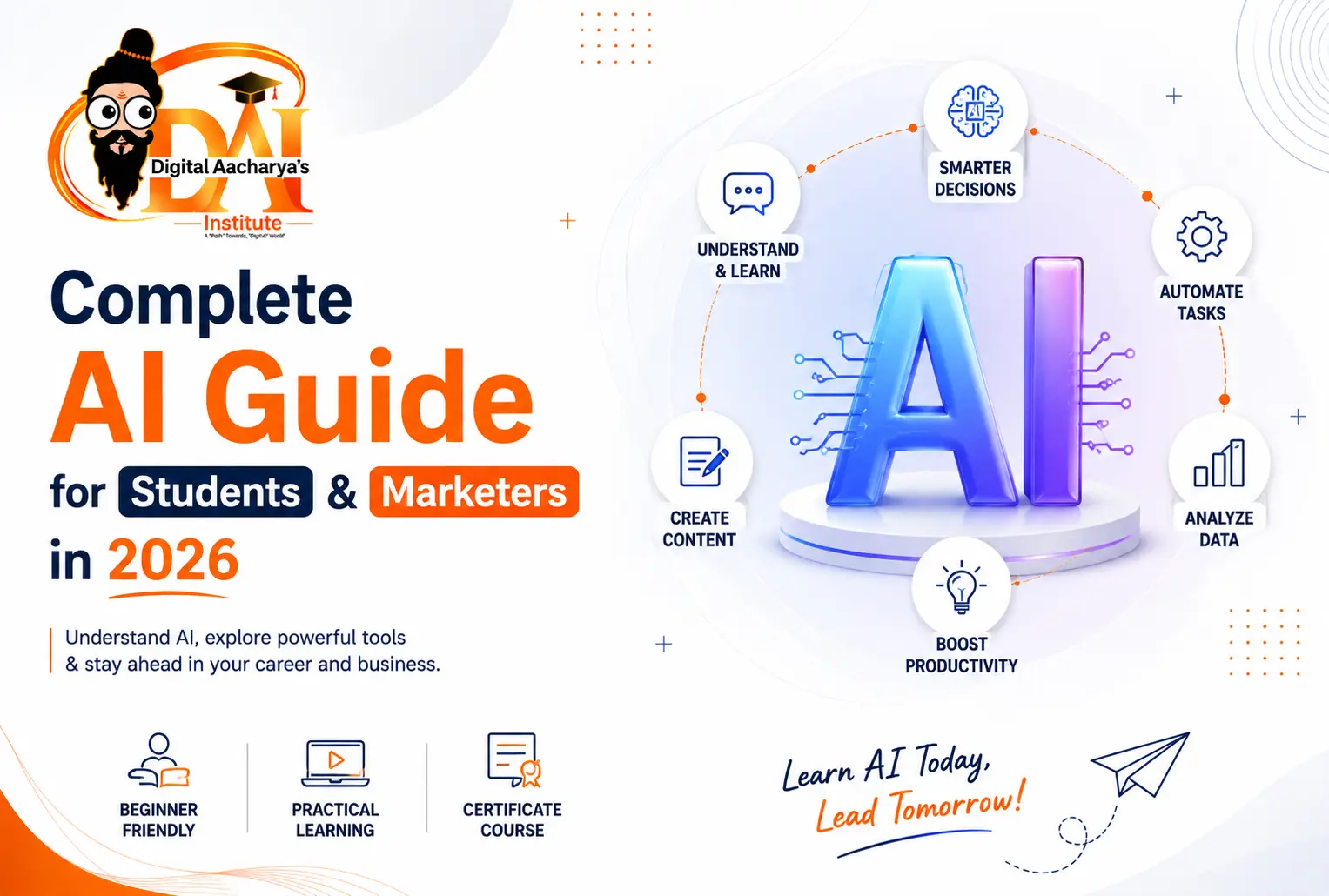
Artificial Intelligence (AI) is a technology that enables computers and software to perform tasks that typically require human intelligence, such as understanding language, generating content, recognizing patterns, analyzing data, solving problems, and making recommendations. Today, AI is used across industries including Digital Marketing, business, education, healthcare, customer service, and productivity.
Many people already use AI in their daily lives without realizing it. From getting directions on Google Maps to receiving movie recommendations on Netflix or interacting with AI-powered chatbots, Artificial Intelligence has become a part of everyday digital experiences.
Artificial Intelligence Definition
Artificial Intelligence refers to the ability of machines and computer systems to simulate certain aspects of human intelligence. AI systems can learn from data, identify patterns, understand instructions, generate responses, and assist users in completing tasks more efficiently.
It is important to understand that AI is a tool designed to assist humans, not replace human thinking, creativity, or decision-making. The most effective use of AI happens when human expertise and AI capabilities work together.
How AI Works
AI works by processing large amounts of data and identifying patterns within that information. Using algorithms and machine learning models, AI systems learn from existing data and use that knowledge to generate predictions, recommendations, insights, or responses.
For example, when you ask ChatGPT a question, use Google Maps for navigation, or receive personalized recommendations on Netflix, AI analyzes available data and provides a relevant output based on patterns it has learned.
Modern AI tools can help users create content, conduct research, automate repetitive tasks, generate images, analyze information, and improve productivity across a wide range of activities.
Real-World Examples of AI
Artificial Intelligence is already being used by millions of people every day through tools and applications such as:
As AI adoption continues to grow, thousands of AI tools are being developed to help students, professionals, freelancers, business owners, and marketers work more efficiently. At Digital Aacharya's Institute, students are introduced to more than 1000 AI tools and use cases relevant to modern careers and businesses.
Why is AI Important in 2026?
Artificial Intelligence has become one of the most influential technologies of 2026. What was once considered a future innovation is now being used daily by students, professionals, marketers, business owners, and organizations across industries. From content creation and research to automation and decision-making, AI is changing how people work, learn, and solve problems.
As AI adoption continues to grow, understanding how to use AI effectively is becoming a valuable skill rather than an optional one. Those who learn to work alongside AI can improve productivity, adapt to changing industry requirements, and gain a competitive advantage in both their careers and businesses.
AI is Becoming Mainstream
AI-powered tools are now used across education, healthcare, marketing, finance, customer service, and e-commerce. From ChatGPT for research to AI-powered recommendations on streaming platforms, AI has already become part of everyday life — making it an important digital skill to understand.
AI Improves Productivity
AI helps people complete tasks faster — assisting with research, content creation, data analysis, brainstorming, automation, and reporting. Rather than replacing expertise, it frees up time for strategy, creativity, and higher-value work, which is why adoption keeps growing.
AI Creates New Career Opportunities
The rise of AI has created demand for professionals who understand AI tools, Prompt Engineering, automation, and AI-assisted workflows. Learning AI today helps students and professionals position themselves for emerging roles and stand out in a competitive job market.
AI is Transforming Businesses
Businesses use AI to improve efficiency, reduce manual work, enhance customer experience, and make better decisions — supporting content creation, customer support, marketing automation, and reporting. Professionals who understand both business and AI are increasingly valuable.
AI is Changing How We Learn and Work
One of the strongest skill combinations today is AI and Digital Marketing. At Digital Aacharya's Institute, the focus is on practical AI use cases you can apply in real careers, businesses, and marketing activities — using AI as a genuine productivity and growth tool.
Why Learn AI from Industry Professionals?
Artificial Intelligence is evolving at an incredible pace. New AI tools, features, and technologies are being introduced regularly, making it one of the fastest-changing fields today. Because of this, learning AI from outdated course material or tool demonstrations alone is often not enough.
While understanding AI concepts is important, real value comes from knowing how AI is applied in practical situations to solve problems, improve productivity, automate tasks, create content, support decision-making, and drive business growth. This is where learning from professionals actively working with AI can make a significant difference.
At Digital Aacharya's Institute, the focus is not only on understanding AI but also on learning how to use it effectively in real-world scenarios. Students are introduced to more than 1000 AI tools and use cases relevant to modern careers, businesses, productivity, content creation, marketing, research, and automation.
Many of the trainers are active industry professionals associated with First DigiAdd LLP, where AI is used alongside Digital Marketing, content creation, workflow automation, research, campaign planning, and business operations. This exposure helps learners understand how AI is implemented in actual business environments rather than only learning theoretical concepts.
Students are encouraged to explore practical AI applications, Prompt Engineering techniques, AI-assisted workflows, and productivity systems that can be applied across different industries. Instead of focusing only on individual tools, the emphasis is placed on understanding how AI can help solve real problems and improve efficiency.
Another important advantage is learning the integration of AI and Digital Marketing. As businesses increasingly adopt AI-powered content creation, automation, analytics, and customer engagement strategies, professionals who understand both AI and Digital Marketing are becoming highly valuable in the modern job market.
Ultimately, learning AI is not about memorizing tool names or following trends. It is about developing the ability to use AI effectively, adapt to new technologies, and apply AI-powered solutions in real-world situations.
How Does AI Work?
Artificial Intelligence works by learning from information, identifying patterns, and using those patterns to generate useful outputs. While the technology behind AI can be complex, the basic idea is simple: AI studies data, learns from it, and then uses that learning to assist users in completing tasks or answering questions.
Think of AI as a highly advanced assistant that has learned from large amounts of information and can use that knowledge to provide relevant responses, recommendations, predictions, and content.
Data
Data is the foundation of Artificial Intelligence. AI systems learn by analyzing large amounts of information such as text, images, videos, documents, websites, customer interactions, and other digital content. Just as humans learn by reading books, watching videos, and gaining experience, AI learns by processing data and identifying patterns within it.
Algorithms
Algorithms are sets of instructions that tell AI how to process information and identify patterns. They help AI understand relationships between different pieces of data and determine the most relevant response or action. For example, when Google Maps suggests the fastest route or Netflix recommends a movie, algorithms help analyze available information and provide recommendations based on patterns.
Machine Learning
Machine Learning is a branch of AI that allows systems to improve over time by learning from data. Instead of being programmed for every possible situation, Machine Learning helps AI recognize patterns and make better predictions based on previous information. For example, email platforms learn to identify spam messages, and recommendation systems learn what type of content users are most likely to enjoy.
Generative AI
Generative AI is a type of Artificial Intelligence that can create new content based on the information it has learned from. Tools such as ChatGPT, Gemini, AI image generators, and AI video tools use Generative AI to produce text, images, videos, presentations, code, and other forms of content. This is one of the main reasons AI has become so popular among students, professionals, marketers, and business owners in recent years.
AI Outputs
Once AI processes data, applies algorithms, and learns patterns, it generates an output. This output may be an answer to a question, a content draft, an image, a recommendation, a report, a prediction, or a suggested action.
For example:
The good news is that you do not need coding knowledge to understand how AI works or to start using AI tools effectively. For most students, professionals, marketers, and business owners, understanding AI concepts and practical applications is far more important than learning complex technical development.
Key Benefits of Artificial Intelligence
Artificial Intelligence offers several advantages that help students, professionals, marketers, freelancers, and businesses work more efficiently. Rather than replacing human abilities, AI helps people save time, improve productivity, make better decisions, and focus on higher-value activities.
Faster Work
One of the biggest benefits of AI is speed. Tasks that previously required hours of research, content creation, data analysis, or information gathering can often be completed much faster with the help of AI tools.For example, students can summarize large topics quickly, marketers can generate content ideas, and business owners can create marketing materials in a fraction of the time traditionally required.
Better Decision Making
AI can analyze large amounts of information and identify patterns that may be difficult for humans to spot manually. This helps individuals and businesses make more informed decisions based on data rather than assumptions. For example, businesses use AI to understand customer behavior, marketers use AI to optimize campaigns, and professionals use AI-powered insights to improve productivity and planning.
Automation of Repetitive Tasks
Many routine and repetitive tasks can be automated using AI. Activities such as responding to common customer questions, organizing information, generating reports, scheduling content, and managing workflows can be handled more efficiently with AI-powered tools. This allows individuals and businesses to spend less time on repetitive work and more time on strategy, creativity, and problem-solving.
Increased Productivity
AI helps people accomplish more work in less time. Students can learn faster, professionals can streamline daily tasks, marketers can create and manage campaigns more efficiently, and business owners can improve operations without significantly increasing resources.When used correctly, AI becomes a productivity partner that helps users work smarter rather than harder.
New Career Opportunities
As AI adoption continues to grow across industries, demand for professionals who understand AI tools and workflows is increasing. Businesses are actively looking for individuals who can use AI for content creation, research, automation, marketing, customer support, and business operations.For students and working professionals, learning AI can open opportunities in emerging fields such as Prompt Engineering, AI-assisted content creation, AI automation, AI consulting, and AI-powered Digital Marketing. Professionals who combine domain expertise with AI skills are likely to have a strong advantage in the future job market.
Types of Artificial Intelligence
Artificial Intelligence is a broad field that includes different technologies designed to perform specific tasks. While there are many ways to classify AI, beginners should understand the most common types that are used in everyday applications and modern AI tools.
Narrow AI
Narrow AI is the most common type of Artificial Intelligence used today. It is designed to perform specific tasks rather than think like a human. Most AI tools and applications people use daily fall into this category. Examples of Narrow AI include Google Maps suggesting routes, Netflix recommending movies, spam filters in email platforms, and AI-powered customer support systems.
Generative AI
Generative AI is a type of AI that can create new content such as text, images, videos, presentations, and code. This is the category that has gained massive popularity in recent years.Tools such as ChatGPT, Gemini, AI image generators, and AI video creation platforms use Generative AI to help users create content, answer questions, brainstorm ideas, and improve productivity.
Machine Learning
Machine Learning is a branch of AI that allows systems to learn from data and improve over time without being explicitly programmed for every situation.For example, Netflix learns what type of movies you enjoy, Google Maps learns traffic patterns, and recommendation systems improve suggestions based on user behavior. The more relevant data these systems receive, the better they become at making predictions and recommendations.
Deep Learning
Deep Learning is an advanced form of Machine Learning that helps AI handle more complex tasks such as understanding language, recognizing images, generating content, and processing large amounts of information.Many modern AI tools, including ChatGPT, Gemini, voice assistants, image recognition systems, and AI image generators, rely on Deep Learning technologies to deliver accurate and intelligent outputs.
Conversational AI
Conversational AI is designed to communicate with humans through natural conversations. It can understand questions, provide answers, assist users, and perform tasks through text or voice interactions. Examples of Conversational AI include ChatGPT, Gemini, AI customer support chatbots, virtual assistants, and voice-based AI systems. These tools are widely used for learning, research, customer service, productivity, and business communication. Understanding these different types of AI helps learners recognize how Artificial Intelligence is being used across industries and why AI has become an important part of modern education, business, Digital Marketing, and everyday life.
Most Popular AI Tools in 2026
Thousands of AI tools are available today, helping users with content creation, research, productivity, design, automation, video creation, and business tasks. While new tools continue to emerge, some platforms have become widely adopted because of their ease of use and practical applications.Whether you are a student, marketer, freelancer, working professional, or business owner, understanding these popular AI tools can help you work more efficiently and stay competitive in an AI-driven world.

ChatGPT
(Content Creation & Productivity)ChatGPT is one of the most widely used AI tools in the world. It helps users generate content, conduct research, brainstorm ideas, summarize information, create marketing materials, write emails, and solve problems through natural conversations.Students use ChatGPT for learning and research, while marketers, freelancers, and business owners use it for content creation, planning, and productivity tasks.Learn more in our Complete ChatGPT Guide.

Gemini
(Research & AI Assistance)Gemini is Google's AI-powered assistant designed to help users with research, content generation, problem-solving, and information discovery. It integrates with Google's ecosystem and is often used for learning, planning, and productivity-related tasks.Students and professionals frequently use Gemini for gathering information, exploring topics, and generating ideas more efficiently.Learn more in our Complete Gemini Guide.

Claude
(Writing & Long-Form Content)Claude is an AI assistant known for handling long documents, detailed analysis, content writing, and structured responses. Many professionals use Claude for report creation, content drafting, research assistance, and document analysis.Its ability to process large amounts of information makes it useful for students, writers, marketers, and business professionals.Learn more in our Complete Claude AI Guide.

Perplexity
(AI Search & Research)Perplexity combines AI with search capabilities to provide answers supported by sources and references. It is particularly useful for research, fact-finding, learning new topics, and exploring detailed information.Students, professionals, and researchers often use Perplexity when they need information quickly without manually searching through multiple websites.Learn more in our Complete Perplexity AI Guide.

Midjourney
(AI Image Generation)Midjourney is one of the most popular AI image generation tools. Users can create high-quality visuals, illustrations, concept art, marketing creatives, and design ideas using text prompts.Designers, marketers, content creators, and businesses use Midjourney to generate unique visual content without traditional graphic design processes.Learn more in our Complete Midjourney Guide.

Canva AI
(Design & Content Creation)Canva AI combines design tools with AI-powered features to help users create social media posts, presentations, marketing materials, videos, and graphics quickly.Because of its beginner-friendly interface, Canva AI is widely used by students, marketers, freelancers, educators, and business owners who want professional-looking designs without advanced design skills.Learn more in our Complete Canva AI Guide.

Notion AI
(Productivity & Organization)Notion AI helps users organize information, summarize notes, generate content, manage projects, and improve productivity. It is commonly used for knowledge management, task planning, documentation, and workflow organization.Professionals, teams, and students use Notion AI to streamline daily work and manage information more efficiently.Learn more in our Complete Notion AI Guide.

Runway
(AI Video Creation)Runway is an AI-powered video creation and editing platform that helps users generate videos, edit content, remove backgrounds, create visual effects, and produce creative video projects. Marketers, content creators, agencies, and businesses use Runway to create video content faster while reducing production time and effort. Learn more in our Complete Runway AI Guide. As AI continues to evolve, new tools will emerge and existing platforms will become even more powerful. While learning individual tools is important, understanding how to apply AI effectively is even more valuable. At Digital Aacharya's Institute, learners are introduced to more than 1000 AI tools and practical use cases, helping them understand how AI can be used across education, Digital Marketing, business operations, productivity, content creation, and automation.
How AI is Used in Digital Marketing
Artificial Intelligence is transforming the way Digital Marketing is planned, executed, and optimized. Today, marketers use AI to create content, analyze data, automate repetitive tasks, improve advertising performance, and increase productivity.
However, AI should be viewed as a powerful assistant rather than a replacement for marketers. While AI can help generate ideas and automate workflows, human creativity, strategy, customer understanding, and decision-making remain essential for successful marketing campaigns.
As businesses increasingly adopt AI-powered tools, professionals who understand both Digital Marketing and AI are gaining a significant advantage in the modern job market.
AI Content Creation
AI tools can assist marketers in generating content ideas, blog outlines, social media captions, ad copies, email drafts, and marketing campaigns. This helps reduce the time required for content planning and creation.
However, one of the most common mistakes beginners make is publishing AI-generated content without reviewing it. While AI can create content quickly, human editing is important to ensure accuracy, originality, brand voice, and relevance to the target audience.
AI SEO
AI is helping marketers perform keyword research, content planning, competitor analysis, SEO audits, and search intent analysis more efficiently. Instead of spending hours manually collecting information, marketers can use AI tools to identify opportunities and make faster decisions.
However, AI does not replace SEO strategy. Understanding user intent, creating valuable content, improving website experience, and building authority still require human expertise and decision-making
AI Social Media Marketing
Social Media Marketers use AI to generate content ideas, create captions, develop content calendars, research trends, suggest hashtags, and brainstorm campaign concepts.
AI can significantly speed up content creation and planning, allowing marketers to spend more time on audience engagement, community building, and creative strategy. Businesses that combine AI efficiency with authentic human communication often achieve better social media results.
AI Advertising
AI is widely used in digital advertising to improve audience targeting, campaign optimization, bid management, and ad performance analysis. Marketers can also use AI tools to create ad copy variations, generate creative ideas, and test multiple campaign approaches more efficiently.
While AI helps improve advertising performance, successful campaigns still depend on understanding customer behavior, crafting effective offers, and developing strong marketing strategies.
AI Automation
Many repetitive marketing activities can now be automated using AI. Businesses use AI-powered tools for email automation, lead nurturing, customer support chatbots, content scheduling, reporting, workflow management, and customer communication.Automation helps marketers save time and focus on higher-value activities such as strategy, creativity, problem-solving, and business growth.One common mistake businesses make is assuming that automation alone will solve marketing challenges. In reality, automation works best when supported by clear goals, effective processes, and human oversight.
As AI adoption continues to grow, one thing is becoming increasingly clear: AI and Digital Marketing are no longer separate skills. Professionals who understand both are often better equipped to create content, improve productivity, analyze data, automate workflows, and achieve stronger marketing results.AI will not replace Digital Marketers, but Digital Marketers who know how to use AI may replace those who do not.
AI Analytics
AI can process large amounts of marketing data and identify patterns much faster than manual analysis. Marketers use AI-powered tools to understand customer behavior, monitor campaign performance, identify trends, and generate reports.
This allows businesses to make more informed decisions based on data rather than assumptions. AI-powered analytics can help marketers focus on opportunities, improve campaign effectiveness, and optimize marketing investments.
Common Mistakes Beginners Make with AI
Many beginners struggle to get the best results from AI because of how they use it rather than limitations of the technology itself. Common mistakes include copy-pasting AI-generated content without reviewing it, using vague prompts that lead to generic responses, depending completely on AI outputs instead of applying human judgment, ignoring fact-checking and verification, and constantly chasing new AI tools instead of learning how to use a few tools effectively. In most cases, better prompts, critical thinking, human review, and practical implementation lead to significantly better results than simply using more AI tools.
What is Prompt Engineering?
Prompt Engineering is the skill of giving clear and effective instructions to AI tools in order to get better results. Whether you use ChatGPT, Gemini, Claude, AI image generators, or other AI platforms, the quality of the output often depends on the quality of the prompt provided by the user.
As AI becomes more integrated into education, business, Digital Marketing, and productivity workflows, Prompt Engineering is emerging as one of the most valuable practical skills for working effectively with AI.
What is a Prompt?
A prompt is the instruction, question, or request that you give to an AI tool. The AI uses this input to understand what you want and generate a relevant response.
For example:
Basic Prompt:
Write a blog about Artificial Intelligence.
Detailed Prompt:
Write a 1000-word beginner-friendly blog on Artificial Intelligence in Digital Marketing for students. Include examples, benefits, FAQs, and a conclusion.
The second prompt provides more context and instructions, which typically leads to a better result.
Why Prompt Engineering Matters
One of the biggest misconceptions about AI is that all users receive the same results from the same tool. In reality, different prompts can produce completely different outputs.
A common classroom observation is that two students use the same AI tool, but one receives a much better response than the other. The difference is often not the AI platform itself but the quality of the instructions provided.
Prompt Engineering helps users communicate more effectively with AI tools, resulting in better content, more accurate answers, improved productivity, and more useful outputs.
Good Prompt vs Bad Prompt
The difference between a good prompt and a bad prompt is usually the amount of clarity and context provided.
Bad Prompt:
Create an Instagram caption.
Good Prompt:
Create an Instagram caption for a Digital Marketing Institute in Pune promoting an AI course for students and working professionals. Keep the tone professional and include a call-to-action.
The good prompt clearly defines the audience, objective, context, and tone, making it easier for the AI to generate a useful response.
Prompt Engineering for Beginners
Beginners do not need technical knowledge to start learning Prompt Engineering. A simple way to improve prompts is to include:
Many beginners focus on learning more AI tools, but experienced users often understand that learning how to communicate with AI effectively is even more important. Strong Prompt Engineering skills can be applied across ChatGPT, Gemini, Claude, AI image generators, and many future AI platforms.
At Digital Aacharya's Institute, Prompt Engineering is taught as a practical skill that helps students, marketers, freelancers, working professionals, and business owners get more value from AI tools and improve the quality of their results.
Can Students Learn AI?
Yes. Students, graduates, working professionals, freelancers, business owners, and individuals from non-technical backgrounds can learn and use AI effectively. Contrary to popular belief, Artificial Intelligence is no longer limited to engineers or software developers. Many modern AI tools are designed for everyday users and can be used without coding knowledge.
One of the most common misconceptions is that AI can only be learned by people with a technical background. In reality, many learners begin by using AI tools for practical tasks and gradually develop a deeper understanding of AI applications over time.
Students
Students can use AI to improve learning, research, note-taking, productivity, content creation, and problem-solving. Learning AI early can provide a competitive advantage and help students prepare for future academic and career opportunities.
Many students today use AI tools to learn faster, organize information, and explore new skills more efficiently.
Graduates
Graduates can use AI to enhance employability, improve productivity, and develop skills that are increasingly valued across industries. Understanding AI can also complement existing qualifications and help candidates stand out in a competitive job market.
Whether someone comes from a Commerce, Arts, or Science background, AI skills can be applied across a wide range of career paths
Working Professionals
Working professionals use AI to automate routine tasks, conduct research, create content, analyze information, and improve workplace productivity. AI can help professionals complete tasks more efficiently and focus on higher-value activities that require human judgment and expertise.
Business Owners
Business owners can use AI for content creation, customer communication, Digital Marketing, workflow automation, research, and business planning. AI helps reduce manual effort and allows businesses to operate more efficiently while improving customer engagement and productivity.
Freelancers
Freelancers can use AI to improve service delivery, generate ideas, create content, manage projects, conduct research, and increase productivity. AI can help freelancers work more efficiently and serve clients more effectively across multiple industries.
Housewives
Housewives who want to learn new skills, start freelancing, support a family business, or improve productivity can also benefit from AI tools. Many AI applications are beginner-friendly and can be used without prior technical experience.
It is important to understand that learning practical AI usage is different from becoming an AI developer. Most people start by learning how to use AI tools effectively for everyday tasks, productivity, business activities, and career growth. For these applications, no technical background or coding knowledge is required.
Is AI a Good Career in 2026?
Yes. Artificial Intelligence is one of the most promising career fields in 2026 because businesses across industries are adopting AI tools to improve productivity, automation, content creation, customer engagement, and decision-making. As AI becomes a part of everyday work, professionals who understand how to use AI effectively are gaining a significant advantage in the job market.
It is also important to understand that an AI career is not limited to software developers or Machine Learning engineers. AI is creating opportunities for marketers, content creators, business professionals, freelancers, consultants, analysts, and many other roles.
Industry Growth
AI adoption is growing rapidly across industries including Digital Marketing, education, healthcare, finance, e-commerce, customer service, and business operations. Organizations are investing in AI-powered tools to improve efficiency, reduce manual work, and support better decision-making.
As AI becomes more integrated into everyday business activities, professionals who understand AI are becoming increasingly valuable across multiple sectors.
Demand
The demand for AI-related skills continues to increase as businesses look for ways to improve productivity and stay competitive. However, many companies are not necessarily hiring "AI experts." Instead, they are hiring professionals who know how to use AI effectively within their existing roles.
For example, a Digital Marketer who understands AI, a content creator who uses AI tools, or a business professional who can automate workflows may have an advantage over someone who lacks these skills.
AI Job Roles
The growth of AI has created new career opportunities and expanded existing job roles. Some emerging AI-related roles include:
addition, AI knowledge can improve opportunities in many non-AI careers by helping professionals work more efficiently and deliver better results.
Future Opportunities
AI should be viewed as a skill that complements existing careers rather than replacing them. As businesses continue to adopt AI, professionals who combine industry expertise with AI skills are likely to have stronger career opportunities in the future.
For beginners, learning AI tools is often a faster and more practical starting point than pursuing advanced AI development. Many successful professionals begin by learning how to use AI for productivity, content creation, research, automation, and business tasks before exploring more technical areas.
One of the strongest skill combinations in today's market is AI and Digital Marketing. Businesses are actively seeking professionals who can combine marketing knowledge with AI-powered tools to create content, analyze data, automate workflows, and improve business performance.
Students who start learning AI today are not only preparing for emerging job roles but also developing a valuable skill that can support careers across a wide range of industries.
AI Career Opportunities
Artificial Intelligence is creating new career opportunities while also transforming many existing job roles. As businesses continue to adopt AI tools, professionals who understand how to use AI effectively are becoming increasingly valuable across industries.
It is important to understand that the exact job titles may vary from company to company, but the underlying AI skills are becoming more relevant in areas such as content creation, marketing, automation, productivity, business operations, consulting, and training.
Many organizations are not only hiring for dedicated AI roles but are also expecting employees to use AI tools as part of their everyday work.
Prompt Engineer
Prompt Engineers focus on creating effective instructions for AI tools to generate high-quality outputs. They understand how to communicate with AI systems efficiently and optimize prompts for content creation, research, automation, problem-solving, and business applications. As AI adoption grows, Prompt Engineering is becoming a valuable skill across multiple industries rather than being limited to a single job role.
AI Content Specialist
AI Content Specialists use AI tools to create, optimize, and manage content for websites, blogs, social media platforms, advertisements, emails, and other digital channels.These professionals combine content strategy, creativity, and AI-assisted workflows to improve efficiency while maintaining quality and relevance.
AI Automation Specialist
AI Automation Specialists help businesses automate repetitive tasks and workflows using AI-powered tools and systems. Their work may involve automating customer communication, content workflows, reporting processes, data management, and business operations.As companies look for ways to improve productivity, automation-related opportunities continue to grow.
AI Marketing Specialist
AI Marketing Specialists combine Artificial Intelligence with Digital Marketing to improve content creation, audience research, campaign optimization, analytics, advertising, and customer engagement.As businesses increasingly adopt AI-powered marketing tools, professionals who understand both AI and Digital Marketing are becoming highly valuable. In today's market, AI and Digital Marketing represent one of the strongest skill combinations for career growth.
AI Consultant
AI Consultants help businesses understand, adopt, and implement AI solutions that align with their goals. They identify opportunities where AI can improve efficiency, productivity, customer experience, and business performance.As AI adoption expands, many businesses seek guidance on how to use AI effectively without disrupting existing operations.
AI Trainer
As demand for AI education continues to increase, AI Trainers help students, professionals, teams, and organizations understand AI concepts, tools, Prompt Engineering, and practical applications.Professionals with strong AI knowledge and communication skills may find opportunities in training, coaching, workshops, and corporate learning programs.
AI Product Specialist
AI Product Specialists work at the intersection of technology, business, and user experience. They help organizations understand how AI-powered products can solve real problems and deliver value to users.Their role often involves understanding customer needs, evaluating AI solutions, and helping businesses integrate AI tools into their workflows.
As the AI industry continues to evolve, new roles and opportunities will continue to emerge. AI skills can also support freelancing, consulting, entrepreneurship, and career growth in existing professions. Rather than replacing careers, AI is increasingly becoming a skill that enhances professional opportunities across a wide range of industries.
What is the Salary of an AI Professional in India?
The salary of an AI professional in India can vary significantly based on factors such as skills, experience, job role, industry, location, and the ability to apply AI effectively in real-world situations. As AI adoption continues to grow, professionals who understand AI tools and workflows are finding opportunities across multiple industries.
It is important to note that many professionals use AI as part of their existing roles rather than working in dedicated AI positions. For example, Digital Marketers, Content Creators, Business Professionals, Consultants, and Automation Specialists often increase their value by combining their domain expertise with AI skills.
Disclaimer: The salary figures below are approximate and may vary depending on experience, skills, industry, company size, location, market demand, and individual performance.
Freshers
Freshers with practical AI knowledge and an understanding of AI tools may find opportunities in areas such as content creation, Digital Marketing, automation, research, and AI-assisted business operations.
Approximate Salary Range: ₹2.5 LPA – ₹6 LPA+
Mid-Level Professionals
Professionals with a few years of experience who successfully integrate AI into their work can often take on more specialized responsibilities involving automation, AI workflows, content strategy, analytics, and business process improvement.
Approximate Salary Range: ₹6 LPA – ₹12 LPA+
Experienced Professionals
Experienced professionals who combine strong industry knowledge with AI expertise may work in leadership, consulting, automation, strategy, training, or AI implementation roles.
Approximate Salary Range: ₹12 LPA – ₹25 LPA+ (or higher depending on role and expertise)
Freelancers
Freelancers use AI to provide services such as content creation, Prompt Engineering, Digital Marketing, automation setup, research, consulting, and productivity optimization.
Freelance income varies significantly based on skills, services offered, project scope, client base, and experience. Many freelancers charge on a project, hourly, or retainer basis
Consultants
AI Consultants help businesses identify opportunities, implement AI solutions, improve workflows, and increase productivity. Consulting income depends on expertise, business results, industry specialization, and client requirements.
Consultants typically work on project-based engagements, retainers, workshops, or advisory assignments, making earnings highly variable.
AI skills can also increase earning potential even when AI is not part of an official job title. As businesses continue adopting AI-powered tools, professionals who know how to use AI effectively may have an advantage in career growth, job opportunities, and income potential.
How Long Does It Take to Learn AI?
The time required to learn Artificial Intelligence depends on your goals, learning approach, and the depth of knowledge you want to achieve. While becoming an AI developer may require years of technical study, most students, professionals, freelancers, and business owners can start using AI tools effectively within a much shorter timeframe.
For beginners, the first step is understanding AI concepts and learning how popular AI tools are used for productivity, research, content creation, business tasks, and Digital Marketing activities. With consistent practice, many learners become comfortable using AI tools within a few weeks.
As learners gain confidence, they often move on to Prompt Engineering, workflow optimization, automation, and more advanced AI applications. This stage focuses on improving the quality of AI outputs, solving real-world problems, and integrating AI into daily work processes.
A structured learning approach can help learners progress faster by providing guidance, practical exercises, and real-world use cases. For example, some learners begin with AI Tools training to understand popular AI platforms and their applications, while others later explore Prompt Engineering to improve how they communicate with AI and generate better results.
It is important to remember that learning AI is not a one-time activity. New AI tools, features, and technologies continue to emerge, making continuous learning an important part of staying up to date. The goal is not to learn every AI tool available but to develop the ability to adapt, learn quickly, and use AI effectively in real-world situations.
For most people, the journey begins with understanding AI tools and practical applications, followed by continuous improvement through experimentation, practice, and hands-on experience.
How to Start Learning AI?
Learning Artificial Intelligence can feel overwhelming at first because of the large number of tools, technologies, and concepts available today. However, for most beginners, the best approach is to focus on practical usage rather than trying to learn everything at once. The goal is not to become an AI expert overnight. The goal is to understand how AI works, learn how to use AI tools effectively, and gradually apply AI to real-world tasks.
Understand AI Basics
Start by learning the fundamentals of Artificial Intelligence. Understand what AI is, how it works, where it is used, and how it can help individuals and businesses improve productivity.
Before exploring advanced topics, it is important to understand both the capabilities and limitations of AI.
Learn Popular AI Tools
Once you understand the basics, start exploring widely used AI tools such as ChatGPT, Gemini, Claude, Perplexity, Canva AI, and other productivity-focused platforms.
At this stage, the objective is not to master every tool but to understand how different tools can help with content creation, research, learning, automation, design, and problem-solving.
Learn Prompt Engineering
Prompt Engineering is one of the most valuable skills for anyone using AI. Learning how to provide clear instructions helps generate more accurate, useful, and relevant outputs.
Many beginners assume an AI tool is ineffective when the real issue is often the prompt itself. Better prompts generally lead to better results, making Prompt Engineering an important skill regardless of which AI platform you use.
Practice Daily
One of the most common mistakes beginners make is spending too much time watching AI videos and too little time actually using AI tools.
The fastest way to learn AI is through consistent practice. Experiment with prompts, test different tools, explore features, and use AI for everyday tasks. Small daily practice sessions often produce better results than occasional intensive learning.
Apply AI to Real Tasks
Learning becomes more effective when AI is used for practical activities.
For example:
Build AI Projects
Once you become comfortable with AI tools, start creating small projects that solve real problems.
Examples include:
Stay Updated
Artificial Intelligence evolves rapidly. New tools, features, and applications are introduced regularly, making continuous learning important.
Rather than trying to learn every AI tool available, focus on understanding core concepts and staying updated with emerging trends. This makes it easier to adapt as the AI landscape continues to evolve.
At Digital Aacharya's Institute, learners are introduced to more than 1000 AI tools and practical use cases. However, the focus is not on memorizing tool names but on understanding how AI can be applied effectively in education, Digital Marketing, business operations, productivity, and real-world problem-solving.
The most effective way to learn AI is simple: learn the basics, use the tools, practice consistently, and apply AI to real tasks. Learning by doing will always be more valuable than learning by watching alone
Practical Learning Matters More Than Theory
Artificial Intelligence is a practical skill that is best learned through implementation rather than theory alone. Understanding AI concepts, tools, and terminology is important, but real learning happens when AI is applied to solve actual problems, improve productivity, automate tasks, and support decision-making.
Many beginners spend months watching AI videos, reading articles, and exploring new tools without ever applying AI in real-world situations. While learning resources are valuable, confidence and skill development usually come from hands-on experience rather than passive learning.
One of the biggest misconceptions in AI education is that knowing more tools automatically makes someone more skilled. In reality, knowing 1000 AI tools is often less valuable than knowing how to use a few tools effectively to solve real problems. The true value of AI comes from implementation, not tool collection.
A common observation among AI learners is that many spend weeks watching tutorials and tool reviews but struggle to complete practical tasks. In most cases, the biggest improvement happens when learners start applying AI to real projects rather than consuming more content.
Why Theory Alone Is Not Enough
Many people understand what ChatGPT, Gemini, Claude, or other AI tools do, but struggle when asked to use them for content creation, research, productivity, marketing, automation, or business tasks.
Understanding a concept and applying it successfully are two different skills. Practical experience helps bridge that gap and transforms knowledge into real-world capability.
The Importance of Practical Assignments
assignments help learners develop confidence while working with AI tools. Activities such as creating prompts, generating content, building workflows, analyzing information, automating tasks, and solving business challenges allow learners to understand how AI works in realistic situations.
Each practical exercise provides opportunities to experiment, make mistakes, refine prompts, and improve results through experience.
Learning Through Real-World Use Cases
becomes much easier to understand when applied to actual tasks.
For example:
use cases help learners understand not just what AI can do, but how AI can create value in different situations.
AI Workflows
AI skills develop, learners often move beyond individual tools and begin creating AI workflows. An AI workflow combines multiple tools and processes to complete tasks more efficiently.
For example, a marketer might use one AI tool for research, another for content creation, a third for design, and a fourth for automation. Learning how different AI tools work together is often where significant productivity gains occur.
Learning AI Through Practical Implementation
Digital Aacharya's Institute, learners are introduced to more than 1000 AI tools and practical use cases across education, Digital Marketing, business operations, productivity, content creation, and automation. However, the focus is not on memorizing tool names. The focus is on understanding how AI can be applied effectively in real-world situations.
Through practical assignments, Prompt Engineering exercises, workflow creation, and implementation-based learning, students gain hands-on experience that helps them move beyond theory and develop confidence using AI in their careers and businesses.
Ultimately, success with AI comes from experimentation, implementation, and continuous practice. The people who gain the most value from AI are usually not those who know the most tools, but those who know how to use AI effectively to solve real problems
Will AI Replace Human Jobs?
No, AI is unlikely to replace all human jobs. However, it is changing how many jobs are performed. Artificial Intelligence can automate certain tasks, improve productivity, and streamline workflows, but human creativity, strategy, communication, leadership, decision-making, and problem-solving remain difficult to replace.
Many beginners spend months watching AI videos, reading articles, and exploring new tools without ever applying AI in real-world situations. While learning resources are valuable, confidence and skill development usually come from hands-on experience rather than passive learning.
A more realistic way to look at the future is this:
will not replace people. People who know how to use AI may replace those who do not.
As AI becomes more widely adopted, professionals who learn how to work alongside AI are likely to have an advantage in their careers and businesses.
Final Thoughts
Intelligence is no longer a future technology—it is already becoming a part of how people learn, work, create content, make decisions, and grow businesses. From students and professionals to freelancers and business owners, AI is helping individuals improve productivity, automate routine tasks, and solve problems more efficiently.
As AI adoption continues to increase across industries, the demand for professionals who understand AI tools and practical applications is also growing. New career opportunities are emerging, existing job roles are evolving, and businesses are actively exploring ways to use AI to improve operations, marketing, customer engagement, and decision-making.
However, success with AI is not determined by how many tools you know. It is determined by how effectively you can apply AI to real-world situations. Understanding AI concepts, learning Prompt Engineering, building practical skills, and gaining hands-on experience are often far more valuable than simply following the latest AI trends.
For businesses, AI presents opportunities to improve efficiency, reduce repetitive work, enhance customer experiences, and support growth. For individuals, AI can become a valuable skill that complements existing knowledge and creates new career possibilities.
One thing is becoming increasingly clear in 2026: AI is not replacing human potential—it is amplifying it. People who learn how to work alongside AI are likely to be better prepared for the future than those who ignore it.
Among the many opportunities emerging today, AI and Digital Marketing have become one of the most valuable skill combinations. Businesses are actively seeking professionals who can combine creativity, marketing strategy, and AI-powered tools to generate better results, improve productivity, and adapt to a rapidly changing digital landscape.
The future may not belong to the people who know the most AI tools. It may belong to the people who know how to use AI effectively to solve real problems, create value, and continuously adapt to new opportunities.
Frequently Asked Questions
Everything you're wondering about learning Digital Marketing at Digital Aacharya's — answered.
