

What is Digital Marketing?
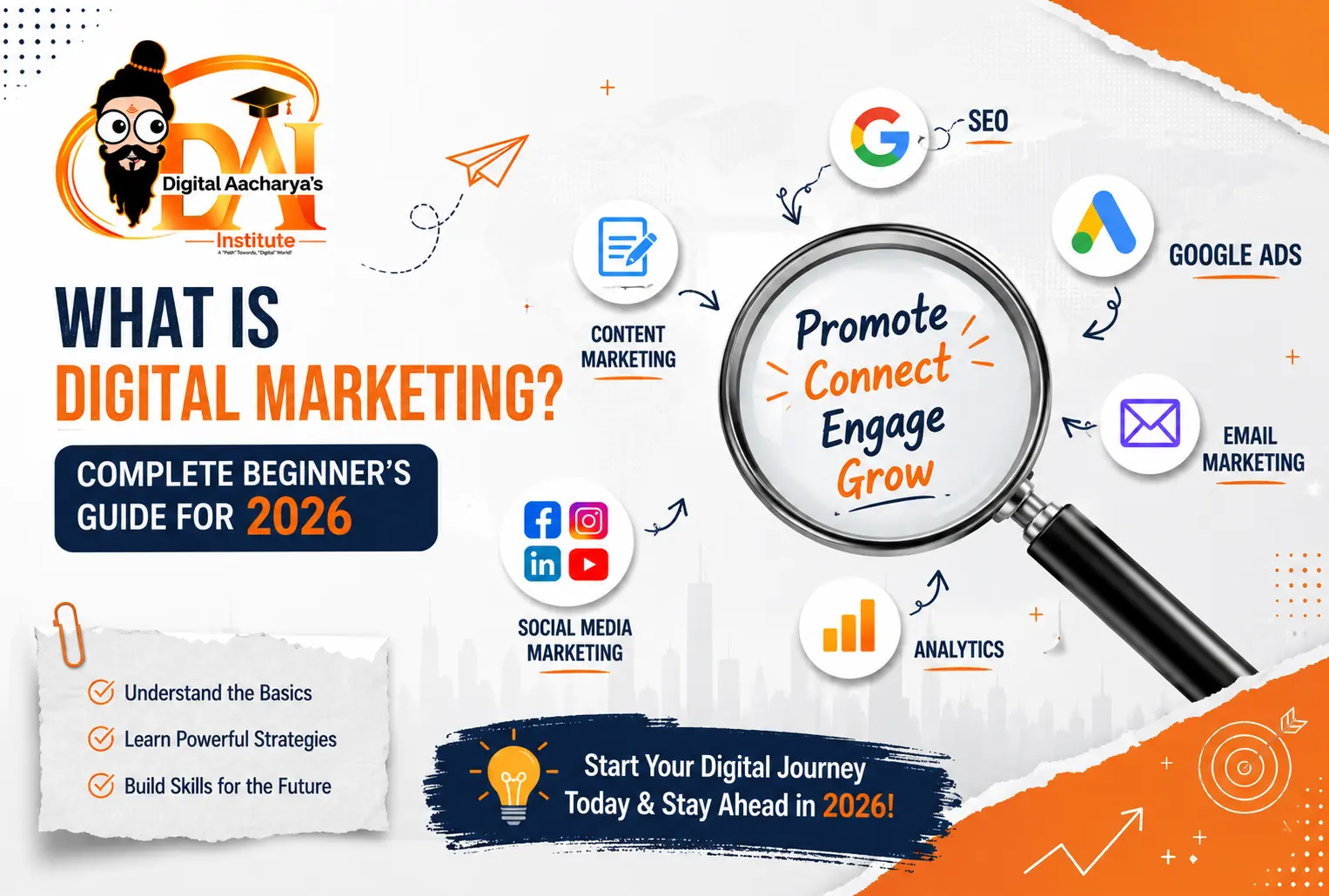
Digital Marketing is the practice of promoting products, services, or brands through online channels such as search engines, social media platforms, websites, email, and digital advertisements. It helps businesses reach their target audience, generate leads, increase brand awareness, and drive sales using internet-based marketing strategies.
Unlike traditional marketing, Digital Marketing allows businesses to connect with potential customers where they spend most of their time online. It also provides measurable results, enabling marketers to track performance and improve campaigns based on real-time data
Whether you search on Google, watch a YouTube video, browse Instagram, read a blog, or click on an online advertisement, you are interacting with Digital Marketing. Today, businesses of all sizes use Digital Marketing to attract customers, build trust, and grow their presence online.
Digital Marketing Definition
Digital Marketing refers to all marketing activities that use the internet and digital technologies to promote a business, product, or service. It includes channels such as Search Engine Optimization (SEO), Social Media Marketing (SMM), Content Marketing, Email Marketing, Pay-Per-Click (PPC) Advertising, Affiliate Marketing, and Marketing Analytics.
For example, when a business ranks on Google, runs Instagram campaigns, sends promotional emails, or uses Google Ads to generate leads, it is using Digital Marketing. The primary goal is to attract potential customers, build engagement, generate leads, and convert them into long-term customers.
What is the Difference Between Traditional Marketing and Digital Marketing?
Traditional Marketing uses offline channels such as newspapers, magazines, television, radio, billboards, and direct mail to reach potential customers. While these methods can still be effective for brand awareness, they often provide limited audience targeting and make it difficult to accurately measure campaign performance.
Digital Marketing takes a more targeted and measurable approach. Businesses can reach specific audiences based on factors such as location, interests, online behavior, and demographics while tracking metrics such as website visits, leads, conversions, engagement, and return on investment (ROI).
For example, a newspaper advertisement may reach thousands of people, but it is difficult to know how many became customers. In contrast, a Google Ads campaign can show exactly how many people clicked the ad, visited the website, submitted an inquiry, or made a purchase. This ability to measure and optimize results is one of the biggest reasons businesses have increasingly adopted Digital Marketing.
Traditional Marketing vs Digital Marketing:
| Traditional Marketing | Digital Marketing |
|---|---|
| Uses offline channels | Uses online channels |
| Limited audience targeting | Advanced audience targeting |
| Difficult to measure results | Real-time performance tracking |
| Higher advertising costs | Flexible budgets and cost control |
| Slower optimization process | Instant campaign optimization |
Because of its ability to target specific audiences, measure results, and optimize campaigns quickly, Digital Marketing has become an essential strategy for businesses of all sizes.
Real-World Examples of Digital Marketing
Digital Marketing is part of our everyday online experience. Whether we are searching on Google, scrolling through social media, watching videos, or reading emails, businesses use Digital Marketing channels to connect with potential customers.
Some common examples include:
- A restaurant in Kharadi appearing in Google Search and Google Maps when users search for "restaurants near me" or "best restaurants in Kharadi."
- A dental clinic in Kharadi using Local SEO and Google Business Profile optimization to attract patients searching for dental services nearby.
- A real estate company in Pune running Google Ads to generate inquiries for residential and commercial property projects.
- A business using Facebook and Instagram to promote offers, share content, and engage with customers through posts, reels, and advertisements.
- An e-commerce store running Google Ads to attract customers searching for specific products online
- A company sending email newsletters to inform subscribers about new products, discounts, and important updates.
- A website using SEO strategies to improve search engine rankings and attract organic traffic from Google.
- A brand publishing blog articles, guides, and educational content to build trust, answer customer questions, and generate leads.
These examples demonstrate how businesses use Digital Marketing to improve visibility, attract customers, generate leads, and drive business growth through various online channels.
Why is Digital Marketing Important in 2026?
Digital Marketing has become an essential part of how businesses attract customers and grow in 2026. As people increasingly use Google, social media platforms, online reviews, and websites to discover products and services, businesses need a strong online presence to remain visible and competitive.
Whether it's a restaurant in Kharadi, a dental clinic in Pune, a real estate company, or an e-commerce brand, customers often begin their buying journey online. Digital Marketing helps businesses reach the right audience, generate leads, build trust, and measure results more effectively than many traditional marketing methods.
At the same time, the growing adoption of Digital Marketing has created new career opportunities for students, professionals, freelancers, and entrepreneurs. As businesses continue to invest in online growth, Digital Marketing remains one of the most valuable skills and business tools in 2026.
Businesses Are Moving Online
Consumer behavior has changed significantly over the past decade. Today, most people search online before making a purchase, booking a service, or visiting a business. They compare options on Google, read reviews, check social media profiles, browse websites, and watch videos before making decisions.
For example, someone looking for a restaurant in Kharadi may search on Google Maps, while a homebuyer in Pune may research property projects online before contacting a real estate company. Businesses that maintain a strong digital presence through search engines, social media, websites, and online reviews are more likely to attract customers, build trust, and stay competitive in an increasingly digital marketplace.
According to recent industry reports, more than 5 billion people worldwide use the internet, making digital channels one of the primary ways businesses connect with customers.
Cost-Effective Marketing
One of the biggest advantages of Digital Marketing is that businesses can start with almost any budget and scale their efforts as they grow. Unlike traditional advertising methods such as television, newspapers, radio, or billboards, Digital Marketing allows businesses to target specific audiences and pay only for relevant reach, clicks, leads, or conversions.
For example, a startup in Pune, a local restaurant in Kharadi, or a small business owner can run targeted campaigns on Google or social media without investing lakhs of rupees in traditional advertising. This flexibility makes Digital Marketing a practical and cost-effective option for startups, freelancers, local businesses, and established companies looking to maximize their marketing budget.
Measurable Results
Unlike many traditional marketing methods, Digital Marketing allows businesses to measure almost every stage of the customer journey. From website visits and ad clicks to leads, inquiries, sales, and customer engagement, marketers can track performance using tools such as Google Analytics, Google Search Console, Google Ads, and social media insights.
For example, if a real estate company in Pune runs a Google Ads campaign, it can see how many people viewed the ad, clicked on it, visited the website, and submitted an inquiry. This level of transparency helps businesses understand what is working, identify areas for improvement, and make data-driven decisions to maximize return on investment (ROI).
Instead of relying on assumptions, Digital Marketing enables businesses to continuously test, optimize, and improve their marketing performance using real-time data.
AI-Powered Marketing
Artificial Intelligence (AI) is transforming the way businesses plan, execute, and optimize their marketing activities. AI-powered tools can assist with content creation, audience research, campaign optimization, customer support, automation, and data analysis, helping businesses work more efficiently and make better decisions.
For example, marketers can use AI tools to generate content ideas, write ad copies, analyze customer behavior, automate repetitive tasks, create marketing reports, and improve campaign performance. This allows businesses to save time while focusing on strategy, creativity, and customer engagement.
However, AI is not replacing Digital Marketers. Instead, it is becoming a powerful tool that enhances productivity and improves results. Professionals who understand both Digital Marketing and AI are increasingly valuable because they can combine human creativity, marketing knowledge, and AI-powered efficiency to achieve better outcomes.
As AI adoption continues to grow, learning how to use AI effectively is becoming an important skill for marketers, freelancers, business owners, and professionals across industries.
Higher Career Opportunities
As businesses continue to invest in online growth, the demand for skilled Digital Marketing professionals continues to increase across industries. Companies actively hire for roles such as SEO Executive, Social Media Marketer, Google Ads Specialist, Content Marketer, Performance Marketer, Digital Marketing Executive, and Digital Marketing Manager.
One of the biggest advantages of Digital Marketing is its versatility. Students, graduates, job seekers, working professionals, freelancers, and business owners can all benefit from learning Digital Marketing. In addition to traditional job opportunities, these skills can be used for freelancing, consulting, personal branding, entrepreneurship, and growing a business online.
With the rise of AI-powered marketing, businesses are increasingly looking for professionals who can combine marketing knowledge with modern tools and technologies. Those who understand both Digital Marketing and AI are likely to have a competitive advantage in the evolving job market.
As technology continues to evolve, Digital Marketing remains one of the most valuable career skills and one of the most effective growth channels for businesses in 2026 and beyond.
Businesses across industries continue increasing their investment in Digital Marketing, creating demand for specialists in SEO, Paid Advertising, Social Media Marketing, Analytics, Content Marketing, and AI-powered marketing.
Why Learn Digital Marketing from Industry Professionals?
Digital Marketing is a practical skill that cannot be mastered through theory alone. While online videos, blogs, and courses can help learners understand concepts, real growth happens when those concepts are applied to actual businesses, marketing campaigns, and customer challenges.
One of the biggest mistakes beginners make is focusing only on learning tools without understanding how businesses use them to generate leads, sales, and growth. This is why learning from professionals who actively work in the industry can make a significant difference.
At Digital Aacharya's Institute, students learn from experienced Digital Marketing professionals with 4 to 7 years of industry experience. Unlike trainers who teach only from pre-designed course material, our trainers are actively involved in Digital Marketing projects through First DigiAdd LLP, where they work with real businesses, marketing campaigns, websites, advertisements, SEO strategies, social media management, and AI-powered marketing solutions.
Because the trainers are working in the field every day, students gain exposure to current industry trends, practical implementation methods, and real-world problem-solving approaches rather than outdated examples. As search engines, social media platforms, advertising systems, and AI technologies continue to evolve, this industry exposure helps keep the learning process aligned with current market requirements.
Students are also encouraged to work on practical assignments, implementation-based activities, and industry-relevant projects that help bridge the gap between learning and execution. Rather than simply understanding what SEO, Social Media Marketing, Google Ads, Local SEO, or AI tools are, learners get an opportunity to understand how businesses actually use these strategies to attract customers and grow online.
Another important advantage is the integration of AI with Digital Marketing. As Artificial Intelligence becomes an essential part of modern marketing, students learn how AI tools can support content creation, research, automation, productivity, campaign planning, and marketing workflows. This combination of Digital Marketing fundamentals and AI adoption helps learners prepare for the evolving demands of the industry.
Ultimately, the goal is not just to complete a course or learn a set of tools. The goal is to develop practical skills, industry awareness, problem-solving ability, and the confidence to apply Digital Marketing strategies in real-world business situations.
How Does Digital Marketing Work?
Digital Marketing works by helping businesses attract the right audience, engage potential customers, and convert them into leads or sales through online channels. While the exact strategy may vary from business to business, most Digital Marketing campaigns follow a structured process.
- Identify the Target Audience:
The first step is understanding who the ideal customers are. Businesses analyze factors such as age, location, interests, online behavior, and purchasing habits to identify the audience most likely to be interested in their products or services. - Create Valuable Content:
Once the target audience is identified, businesses create content that addresses their needs, questions, or problems. This content may include blog articles, social media posts, videos, advertisements, email campaigns, infographics, and website pages designed to attract and engage potential customers. - Drive Traffic:
After creating content, businesses use Digital Marketing channels such as SEO, Google Ads, Social Media Marketing, Email Marketing, and Local SEO to drive visitors to their website, landing pages, or online platforms. The goal is to increase visibility and attract relevant traffic - Generate Leads:
As visitors interact with a website or marketing campaign, businesses encourage them to take specific actions such as filling out a contact form, downloading a resource, subscribing to a newsletter, requesting a quote, or making an inquiry. These interested prospects become leads. - Convert Leads into Customers:
Once leads are generated, businesses use follow-ups, personalized communication, remarketing campaigns, offers, and sales processes to convert potential customers into paying customers. A smooth user experience and strong value proposition play a key role in improving conversions. - Measure and Improve Results:
One of the biggest advantages of Digital Marketing is the ability to measure performance. Businesses can track website traffic, lead generation, conversions, engagement, and return on investment (ROI). These insights help marketers identify what is working, optimize campaigns, and achieve better results over time. - Better Audience Targeting:Unlike traditional advertising, Digital Marketing allows businesses to reach specific audiences based on factors such as location, interests, age, online behavior, and search intent. This helps businesses focus their marketing efforts on people who are more likely to become customers.
- Measurable Performance:Businesses can track website visits, ad clicks, inquiries, conversions, engagement, and return on investment (ROI) using analytics tools. This makes it easier to understand what is working and improve marketing strategies over time.
- Flexible Marketing Budgets:Digital Marketing allows businesses to start with modest budgets and scale campaigns as results improve. This flexibility makes it accessible for startups, local businesses, entrepreneurs, and larger organizations alike.
- Improved Lead Generation:Businesses can use SEO, Google Ads, Social Media Marketing, Content Marketing, Email Marketing, and Local SEO to attract potential customers and generate consistent inquiries from online channels.
- Long-Term Business GrowthA strong digital presence can continue generating visibility, traffic, leads, and brand awareness over time. When combined with consistent marketing efforts, Digital Marketing can support sustainable business growth and customer acquisition.
- SEO Executive
- Social Media Executive
- Google Ads Specialist
- Content Marketer
- Performance Marketer
- Digital Marketing Executive
- Marketing Analyst
- Digital Marketing Manager
- 1. Learn the Fundamentals: Start by understanding how Digital Marketing works as a whole. Learn the basic concepts of search engines, websites, customer journeys, lead generation, online advertising, and digital marketing channels. A strong foundation makes it easier to understand advanced topics later.
- 2. Learn Search Engine Optimization (SEO): SEO is often one of the first practical skills beginners learn. Understanding how Google ranks websites, how keyword research works, and how businesses attract organic traffic helps build a strong marketing mindset.
- 3. Learn Social Media Marketing: Once the fundamentals are clear, focus on how businesses use platforms such as Instagram, Facebook, LinkedIn, and YouTube to build brand awareness, engage audiences, and generate leads. Learning content planning and audience engagement is an important step in the journey.
- 4. Understand Google Ads and Paid Marketing: Paid advertising teaches marketers how to reach potential customers quickly. Learning Google Ads helps beginners understand audience targeting, campaign creation, lead generation, conversion tracking, and marketing budgets.
- 5. Learn AI Tools and Modern Marketing Technologies: In 2026, Digital Marketing and AI go hand in hand. Modern marketers use AI tools for content creation, research, campaign planning, reporting, automation, and productivity. Understanding how to use AI effectively has become an important skill for marketers, freelancers, and business owners.
- 6. Practice on Real Projects: Digital Marketing cannot be mastered through theory alone. The real learning happens when you apply concepts to actual websites, social media pages, advertising campaigns, and business scenarios. Practical implementation helps learners understand what works, what doesn't, and how to solve real-world marketing challenges.
- 7. Build a Portfolio and Gain Experience: As your skills improve, document your work and build a portfolio. This may include SEO projects, social media campaigns, Google Ads campaigns, content creation work, website optimization activities, or business growth case studies. A strong portfolio often demonstrates skills more effectively than certificates alone. Digital Marketing is a field where learning never truly stops. The most successful marketers continuously test ideas, adapt to industry changes, explore new technologies, and stay updated with evolving trends such as AI, automation, and changing consumer behavior.
In simple terms, Digital Marketing follows a continuous cycle of attracting the right audience, providing value, generating leads, converting customers, and improving performance through data-driven decisions
Key Benefits of Digital Marketing
Digital Marketing offers several advantages that make it one of the most effective ways for businesses to attract customers, generate leads, and grow in today's digital world.
Types of Digital Marketing
Digital Marketing is made up of multiple channels, each serving a different purpose in attracting, engaging, and converting customers. Successful businesses often use a combination of these channels to build visibility, generate leads, and drive growth online.
How AI is Changing Digital Marketing in 2026
Artificial Intelligence (AI) is changing Digital Marketing by helping businesses create content faster, analyze customer data more effectively, automate repetitive tasks, improve advertising performance, and make better marketing decisions. In 2026, AI is no longer a future technology—it has become part of everyday marketing activities. Marketers use AI-powered tools for content creation, SEO research, campaign optimization, audience analysis, reporting, and customer engagement.
AI in Digital Marketing
2026Will AI Replace Digital Marketers?
This is one of the most common questions asked by students, professionals, and business owners. While AI can automate certain tasks, it cannot replace human creativity, strategic thinking, communication skills, customer understanding, and decision-making. AI should be viewed as a tool rather than a replacement for marketers. Businesses still need professionals who can create strategies, understand customer psychology, evaluate AI-generated outputs, and make informed marketing decisions. AI will not replace Digital Marketers, but Digital Marketers who know how to use AI may replace those who do not. As AI adoption continues to grow, professionals who combine Digital Marketing knowledge with AI skills will be better positioned for future career opportunities, freelancing, business growth, and leadership roles.
Is Digital Marketing a Good Career in 2026?
Yes, Digital Marketing remains one of the most promising career options in 2026. As businesses continue to invest in online growth, the demand for professionals skilled in SEO, Social Media Marketing, Google Ads, Content Marketing, Analytics, and AI-powered marketing continues to increase across industries.
Industry Growth
The way businesses attract customers has changed significantly. Today, companies rely heavily on websites, search engines, social media platforms, online advertising, and digital content to generate leads and sales. As a result, Digital Marketing has become a core business function rather than an optional marketing channel.
Growing Demand for Digital Marketers
Businesses of all sizes, from local startups and small businesses to large enterprises, require Digital Marketing professionals to manage their online presence and customer acquisition strategies. Industries such as education, healthcare, real estate, e-commerce, finance, hospitality, and technology continue to hire Digital Marketing talent to support their growth.
Popular Digital Marketing Job Roles
Digital Marketing offers a variety of career paths based on individual interests and strengths. Some common roles include:
In addition to traditional jobs, many professionals also build careers through freelancing, consulting, content creation, and entrepreneurship.
Future Opportunities
As Artificial Intelligence, automation, and digital technologies continue to evolve, the role of Digital Marketers is also changing. Businesses increasingly seek professionals who can combine marketing knowledge with AI skills, data analysis, creativity, and strategic thinking.For students, graduates, job seekers, freelancers, business owners, and working professionals, Digital Marketing offers flexible career opportunities, continuous learning, and the ability to work across multiple industries. Digital Marketing is not only a valuable career skill for today, but it is also expected to remain relevant and in demand for years to come as businesses continue to grow online.
Digital Marketing Career Opportunities
One of the biggest advantages of learning Digital Marketing is the variety of career paths available. Depending on your interests and strengths, you can specialize in areas such as search marketing, social media, paid advertising, content creation, analytics, freelancing, consulting, or business growth.
Executive
SEO Executives help websites improve their visibility in search engines such as Google. Their responsibilities include keyword research, content optimization, technical SEO, Local SEO, competitor analysis, and improving organic search rankings.
Google Ads Specialist
Google Ads Specialists create and manage paid advertising campaigns to generate website traffic, leads, and sales. They work on keyword targeting, ad creation, campaign optimization, budget management, and performance tracking.
Social Media Executive
Social Media Executives manage a brand's presence across platforms such as Instagram, Facebook, LinkedIn, YouTube, and X (Twitter). Their responsibilities include content planning, audience engagement, community management, and social media growth strategies.
Content Marketer
Content Marketers create valuable content that attracts, educates, and engages potential customers. This may include blog articles, website content, email campaigns, social media content, videos, case studies, and marketing guides.
Performance Marketer
Performance Marketers focus on generating measurable business results through paid advertising campaigns. They analyze campaign data, optimize conversion rates, improve return on investment (ROI), and drive lead generation through multiple digital channels.
Digital Marketing Manager
Digital Marketing Managers oversee complete marketing strategies and coordinate activities across SEO, social media, advertising, content marketing, analytics, and automation. They are responsible for planning campaigns, managing teams, and achieving business growth objectives.
Freelancer
Many Digital Marketing professionals choose freelancing as a career path. Freelancers can offer services such as SEO, Social Media Marketing, Google Ads, content creation, website optimization, and marketing consulting to clients across different industries.
Consultant
Digital Marketing Consultants help businesses develop and improve their online marketing strategies. They analyze business goals, identify growth opportunities, recommend solutions, and guide companies on digital transformation initiatives.
Entrepreneur
Business owners and entrepreneurs can use Digital Marketing skills to grow their own brands, generate leads, attract customers, and reduce dependence on external agencies. Understanding Digital Marketing can provide a significant advantage when building and scaling a business. The flexibility of Digital Marketing allows individuals to choose a career path that aligns with their interests, whether they prefer creative work, data analysis, advertising, content creation, client management, or business development.
What is the Salary of a Digital Marketer in India?
The salary of a Digital Marketer in India depends on factors such as skills, experience, location, specialization, industry, and company size. Professionals with expertise in areas such as SEO, Google Ads, Performance Marketing, Analytics, and AI-powered marketing often have higher earning potential than generalists.
Freshers
Entry-level Digital Marketing professionals typically start in roles such as SEO Executive, Social Media Executive, Content Executive, or Digital Marketing Executive. Freshers can expect salaries ranging from approximately ₹2.5 LPA to ₹5 LPA, depending on their skills, practical experience, and employer.
Mid-Level Professionals
Professionals with 2 to 5 years of experience often manage campaigns, handle clients, and take responsibility for business growth initiatives. Salaries generally range between ₹5 LPA and ₹10 LPA, depending on specialization and performance.
Professionals
Senior Digital Marketing professionals, team leads, and managers with strong expertise in areas such as Performance Marketing, SEO, Analytics, and Growth Marketing can earn ₹10 LPA or more. Compensation may increase significantly based on leadership responsibilities, business impact, and industry experience.
Freelancers
Freelance Digital Marketers typically earn based on projects, clients, and service offerings. Income can vary widely, with some freelancers working part-time for additional income while others build full-time consulting businesses serving multiple clients.
Owners and Consultants
Agency owners and Digital Marketing consultants generally do not have fixed salary structures. Their earnings depend on factors such as client acquisition, service offerings, team size, reputation, and business growth. Successful agencies and consultants can generate substantially higher income as they scale their operations. While salary is an important consideration, long-term success in Digital Marketing is often driven by continuous learning, practical experience, specialization, and the ability to adapt to new technologies such as AI and marketing automation.
Disclaimer: Salary figures are approximate and may vary based on skills, location, employer, industry, market conditions, and individual performance.
Who Can Learn Digital Marketing?
Marketing is a versatile skill that can be learned by people from different educational, professional, and business backgrounds. Whether your goal is to build a career, grow a business, switch industries, or develop a new skill, Digital Marketing offers opportunities for learners at various stages of their journey. The good news is that no prior experience in Digital Marketing is required. Most beginners start by learning the fundamentals and gradually build practical skills through projects, training, and real-world application.
Students
Students can learn Digital Marketing alongside their studies to develop practical skills, explore career opportunities, and gain an early advantage in the job market.
Graduates
Graduates from any stream can build a career in Digital Marketing. Employers often focus more on skills, practical knowledge, and results than on a specific academic background.
Job Seekers
Digital Marketing provides entry-level opportunities in areas such as SEO, Social Media Marketing, Content Marketing, and Paid Advertising, making it a popular career choice for job seekers.
Job Switchers
Professionals looking to change industries can use Digital Marketing as a pathway into a growing field with diverse career opportunities across multiple sectors.
Freelancers
Freelancers can use Digital Marketing skills to offer services such as SEO, Social Media Marketing, Google Ads management, content creation, and marketing consulting to clients.
Housewives
Housewives looking to restart their careers, develop a new skill, work remotely, or explore freelancing opportunities can learn Digital Marketing without requiring a technical background.
Business Owners
Business owners can use Digital Marketing to generate leads, increase brand awareness, attract customers, and better understand how online marketing channels contribute to business growth.
Working Professionals
professionals can learn Digital Marketing to upgrade their skills, improve career prospects, understand modern marketing strategies, or transition into Digital Marketing-related roles. Regardless of age, profession, or educational background, Digital Marketing is a skill that can be learned through consistent practice, hands-on experience, and a willingness to adapt to new technologies and trends.
How Long Does It Take to Learn Digital Marketing?
The time required to learn Digital Marketing depends on your goals, learning pace, and the level of practical experience you want to gain. While the fundamentals can be learned within a few months, developing confidence through practical implementation and real-world projects usually takes additional time and consistent practice.
Short-Term Learning (Around 2 Months)
A 2-month learning journey is suitable for individuals who already have a basic understanding of Digital Marketing concepts or want to quickly learn the fundamentals. During this period, learners can gain exposure to key areas such as SEO, Social Media Marketing, Google Ads, Content Marketing, and AI-powered marketing tools. While the core concepts can be covered effectively, the shorter duration naturally allows less time for extensive practice and project-based learning. This option is often suitable for learners looking to understand how Digital Marketing works before deciding on a deeper specialization.
Intermediate Learning (Around 3 Months)
A 3-month learning period provides additional time to strengthen both theoretical knowledge and practical implementation. Learners can spend more time applying concepts, practicing skills, and understanding how different Digital Marketing channels work together. This timeline is often beneficial for students, graduates, freelancers, and business owners who want to use Digital Marketing skills in real-world situations. Business owners, in particular, can begin applying strategies to their own businesses while learning under the guidance of experienced professionals, helping them avoid common beginner mistakes and make more informed marketing decisions.
Advanced Learning and Practical Experience (Around 6 Months)
A 6-month learning journey allows for deeper understanding, advanced topics, and significantly more hands-on practice. In addition to learning Digital Marketing concepts, learners can spend more time working on projects, developing problem-solving skills, understanding industry tools, and gaining practical experience. This approach is often preferred by graduates and career-focused learners who want to build a strong foundation before entering the industry. The additional practice and exposure help learners develop the confidence and skills required for long-term career growth. Ultimately, Digital Marketing is a field where learning continues even after completing a course. The most successful marketers combine structured learning with consistent practice, experimentation, and staying updated with industry trends and emerging technologies such as AI.
Can I Learn Digital Marketing Without a Technical Background?
Yes, you can learn Digital Marketing without a technical background. Most areas of Digital Marketing, such as SEO, Social Media Marketing, Content Marketing, Google Ads, Email Marketing, and AI-powered marketing, do not require advanced coding or software development skills.
Digital Marketing focuses more on understanding customer behavior, creating content, analyzing data, generating leads, and using online platforms to promote products and services. While basic website knowledge can be helpful, most Digital Marketing tools are designed for marketers, business owners, and beginners rather than programmers.
As a result, students from Commerce, Arts, Science, Management, and other non-technical backgrounds can successfully build careers in Digital Marketing. The field is also suitable for graduates, job seekers, freelancers, business owners, housewives, and working professionals looking to develop new skills or explore career opportunities.
For example, an SEO Executive focuses on improving website visibility, a Social Media Marketer creates and manages content, and a Google Ads Specialist optimizes advertising campaigns. These roles require problem-solving, creativity, communication, and analytical thinking more than technical expertise.
While some advanced areas may involve basic technical concepts, beginners can start learning Digital Marketing without prior coding knowledge and gradually develop additional skills as they gain experience.
Can I Use Digital Marketing for My Own Business?
Yes, Digital Marketing can be used to promote and grow almost any type of business. Whether you run a local business, service-based company, coaching institute, clinic, restaurant, real estate business, or e-commerce store, Digital Marketing can help you reach potential customers, generate leads, and increase brand visibility online.
Lead Generation
One of the primary goals of Digital Marketing is lead generation. Businesses can use websites, landing pages, content marketing, social media campaigns, and online advertisements to attract potential customers and encourage inquiries, bookings, or sales.
Local SEO
Local SEO helps businesses appear in location-based searches when customers are looking for nearby products or services. For example, a dental clinic, restaurant, or service provider can improve visibility by optimizing local keywords, earning customer reviews, and building a strong online presence.
Social Media Marketing
Platforms such as Facebook, Instagram, LinkedIn, and YouTube allow businesses to connect directly with their audience, build brand awareness, showcase products or services, and engage with potential customers through content, reels, and advertisements.
Google Ads
Google Ads helps businesses reach customers who are actively searching for relevant products or services. Unlike traditional advertising, businesses can target specific keywords, locations, and audiences while tracking inquiries, conversions, and return on investment (ROI).
Google Business Profile
A Google Business Profile is one of the most valuable tools for local businesses. It helps businesses appear in Google Search and Google Maps, display reviews, share contact information, and improve local visibility. A properly optimized Google Business Profile can significantly increase calls, inquiries, website visits, and customer trust. For many business owners, learning Digital Marketing provides greater control over their marketing efforts, helps them better understand customer behavior, and reduces dependence on external agencies for everyday marketing activities.
How to Start Learning Digital Marketing?
best way to learn Digital Marketing is through a combination of structured learning, practical implementation, and continuous practice. While there are many free resources available online, beginners often progress faster when they follow a clear learning roadmap and gain hands-on experience along the way.
Practical Learning Matters More Than Theory
Digital Marketing is a skill-based field where practical implementation plays a much bigger role than memorizing concepts. Understanding topics such as SEO, Social Media Marketing, Google Ads, Content Marketing, Local SEO, Analytics, and AI Tools is important, but real learning happens when those concepts are applied to actual business situations.
Many beginners can explain what SEO or Google Ads is, but struggle when asked to improve a website's rankings, generate leads, analyze campaign performance, or solve real marketing challenges. This is one of the reasons practical exposure is so important in Digital Marketing.
Over the years, Digital Aacharya's Institute has trained more than 2,000 students from different educational and professional backgrounds. One common observation is that students gain confidence much faster when they move beyond theory and start applying what they learn through practical activities, guided implementation, and project-based learning.
Digital Marketing is also one of the fastest-changing industries. Search engines evolve, advertising platforms introduce new features, social media trends change, and Artificial Intelligence continues to reshape marketing workflows. Because of this, learning only from static course material is often not enough. Students benefit most when they learn from professionals who actively work in the industry and can share current strategies, tools, challenges, and real-world examples.
At Digital Aacharya's Institute, many trainers are active Digital Marketing professionals at First DigiAdd LLP. This helps students understand how Digital Marketing strategies are implemented in real business environments rather than only learning theoretical concepts. Under guided supervision, students are exposed to practical assignments, industry tools, implementation techniques, and modern AI-powered marketing workflows.
As AI becomes an important part of Digital Marketing, marketers are expected not only to understand marketing fundamentals but also to know how to use AI tools effectively for research, content creation, automation, reporting, and productivity. The combination of Digital Marketing knowledge and AI adoption is becoming increasingly valuable in today's industry.
Ultimately, success in Digital Marketing does not come from completing a course alone. It comes from applying knowledge, solving real problems, learning from results, adapting to industry changes, and continuously improving through practical experience.
Conclusion
Digital Marketing has become an essential skill for businesses, professionals, and entrepreneurs in an increasingly digital world. As consumers continue to search, compare, and make purchasing decisions online, businesses need effective Digital Marketing strategies to remain visible, generate leads, and drive growth.
At the same time, Digital Marketing continues to create career opportunities across industries. Whether you are a student exploring future career options, a graduate looking for job opportunities, a freelancer building a client base, a working professional upgrading your skills, or a business owner aiming to grow online, Digital Marketing offers practical and versatile opportunities.
The integration of Artificial Intelligence is further transforming the industry, helping marketers improve productivity, automate repetitive tasks, analyze data more effectively, and make better marketing decisions. As a result, professionals who combine Digital Marketing knowledge with AI skills are likely to be better prepared for future opportunities.
Whether your goal is career growth, freelancing, business expansion, or personal skill development, Digital Marketing remains one of the most valuable and future-ready skills to learn in 2026 and beyond.
Written by Vitthal Nikam
Founder,Digital Aacharya's Institute
Digital Marketing Trainer & Industry Practitioner
Frequently Asked Questions
Everything you're wondering about learning Digital Marketing at Digital Aacharya's — answered.
